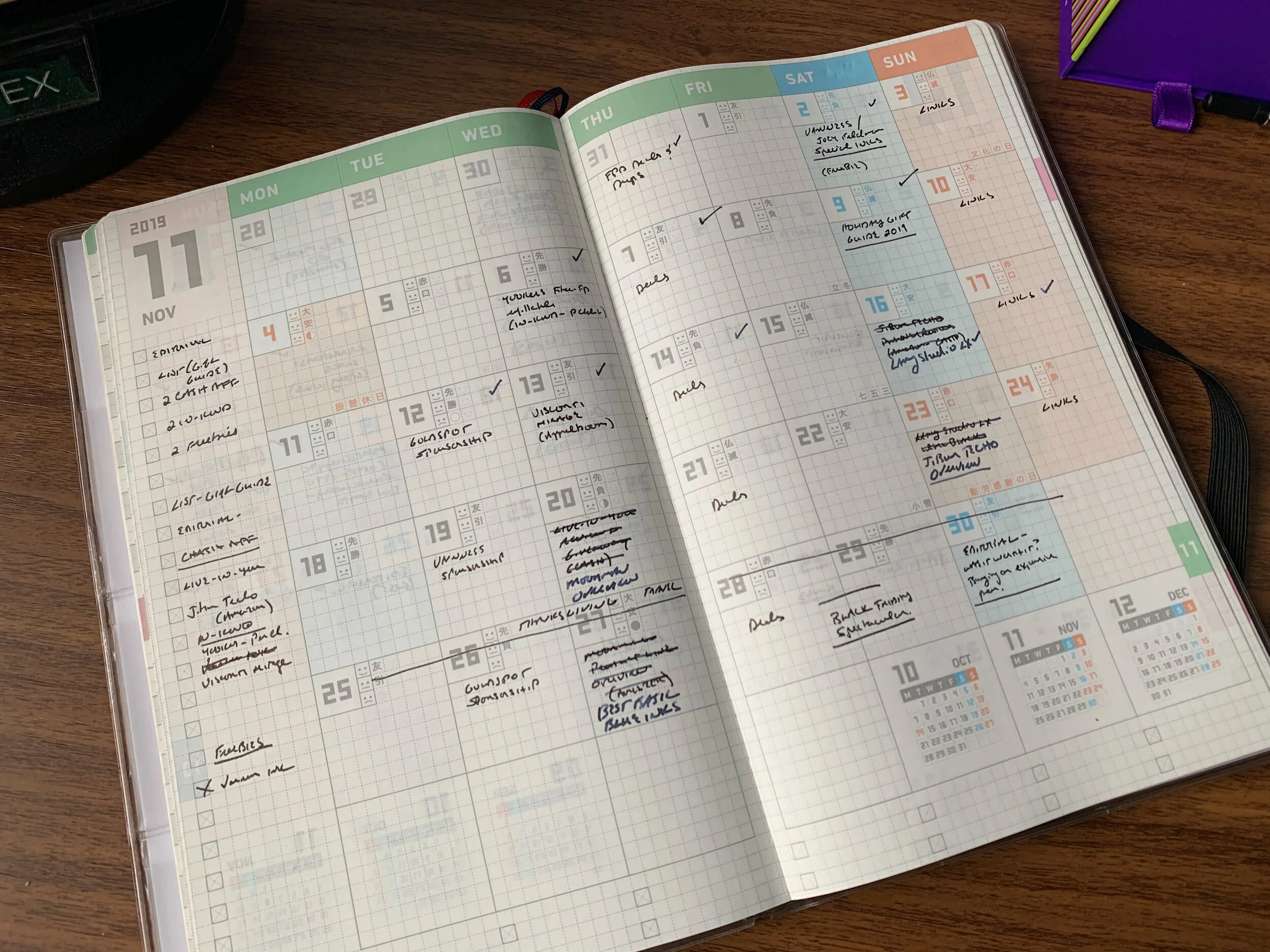
The Jibun Techo is the product of the famous Japanese design company Kokuyo, and its brilliance lies in its modularity, and flexibility; as well as through its uniquely personal yet practical design for organization.
The Central Philosophy: The central tenet of the Jibun Techo is you are the author of your own life. It’s a creative life system to document your own life experiences, and to help you be more intentional with your time. By visually correlating and aligning the following three important aspects of your life:
1. Schedule (What you have to do): Your scheduled and time-limited appointments and deadlines etc.
2. Life (What you actually do): Your daily and lifestyle experiences such as what you do in a typical day, where, when, with whom, how long does it take me to do something, what you eat for meals, pivotal experiences, and experiences you want to remember.
3. Ideas (What you want to do): Your thoughts, aspirations, ideas on what you want to do or accomplish in the future based on your life values.
By visually seeing the interactions and existence of these three important aspects of life in conjunction and situationally expressed together, you will be better able to understand and analyze how you spend your time, and be able to make conscious decisions regarding how you choose to align your daily “life” with your lived values we refer to as our “life goals.”
Key Elements of the System
A typical Jibun Techo starter kit includes three key booklets placed in a single cover, which is well-crafted/beautiful.
1. Life Booklet (This is the “Diary”)
This is the core of the system. It is dated, but has a distinctive vertical time-line layout for each day.
Vertical Time Line: On the left of the daily spread, there is a 24-hour timeline to visualise scheduling plans.
Three Columns (The “Jibun Trilogy”): This is the most recognizable characteristic. Daily pages are divided into three parallel vertical sections.
Schedule: Where your appointments and scheduled-specific tasks would be written.
To-Do/Record: Where any lists, actions and what you did would go.
Memo / Idea / Information: Where any random thoughts, ideas or other details, would be stored.
This way of seeing the entire day, your scheduled tasks, and your overall life at a glance is made possible with these concepts as a whole to compose your Jibun Techo.
2. The Idea Booklet
This is a simple, undated dot-grid or grid notebook. Its purpose is to be a catch-all for everything that does not fit in the structured diary:
- Brainstorming and mind maps
- Meeting notes
- Lists (books to read, movies to watch, projects, etc.)
- Sketches and journaling
3. The Life Booklet (This is the “Address/Info Book”)
A small, structured booklet for fixed information, such as:
Annual and future calendars
Address books
Personal data pages (blood type, sizes, account information)
Maps and conversion charts
4. The Cover
The cover is designed to be durable and reusable. You can buy refills for all of the booklets every year so it is better for the environment.
Who Uses the Jibun Techo?
It has a very diverse audience:
Productivity Enthusiasts: Because they love the analog vs. digital, customizable aspect of the system.
Travelers: It makes a great travel journal to write down itineraries as well as memories of their travels.
Students & Professionals: They can use the Jibun to manage their schedules, projects, and notes all in one largely organized place.
Artists & Writers: The Idea notebook is a great continued resource for collecting inspiration.
Anyone looking for the act of mindfulness: The act of writing things down by hand allows for reflection and intentionality.
The Bottom Line:
“Jibun Techo” is more than simply a notebook; it is a true framework for living purposefully. It is a planner that reveals your time. It is a diary that captures your life. It is a commonplace book that gathers your thoughts. By combining these functions into one traveling system, the Jibun Techo allows you to become the active agent of your own story one day at a time. It is as much a tool for self-exploration as it is for productivity.
