
Commercial aviation is recognized as one of the safest forms of transportation globally. This is in relation to the strict rules and regulations that govern this industry, the technology applied, and the human resources who place more emphasis on safety than on time and convenience. However, at times, unusual occurrences happen that trigger an instant reaction on the part of the airline. United Flight UA770 Emergency Diversion is among such incidents that have attracted public attention and sparked debate on how airlines respond to unusual occurrences in mid-air. This report describes what happened, why the diversion occurred, and its implications for aviation safety.
United Airlines Flight UA770
The involved aircraft was flying United Airlines Flight UA770, which was scheduled to fly from Barcelona in Spain to Chicago in the United States. This particular route was a normal long-haul scheduled flight that takes a normal average of nine hours. The aircraft that was scheduled for the particular flight was a Boeing 787 Dreamliner. The Dreamliner was a wide-body plane that was known for its latest technology.
The plane took off from Barcelona as scheduled, with no signs of any delay or technical problems. The passengers were all settled in for what seemed like a usual, unremarkable flight across the Atlantic. However, events took a turn during the initial stages of the journey.
The Origins of an In-Flight Issue
Approximately one to two hours after takeoff, during cruise, an alert was raised by the onboard systems to the flight crew. These alerts are produced by airplane monitoring systems, which are constantly looking at data for numerous parameters such as engine, cabin, control, and avionics parameters.
In this scenario, what raised concern was an indication of a possible problem with cabin systems, which was not an urgent problem but needed to be closely watched. This is because aircraft design includes redundant systems, and a single problem indication may not be a problem. In aviation, a crew must take an unusual warning seriously, particularly on a long-haul oceanic flight.
Upon consideration of the information and the procedures for the standard operations, the crew concluded that it would not be the safest decision to continue the flight across the Atlantic.
Declaration of Emergency and Diversion Decision
To make sure that they received priority handling and were fully coordinated with air traffic control, the crew members chose to declare an emergency. Declaring an emergency doesn’t necessarily mean that an aircraft is in imminent danger, but it gives air traffic control the chance to clear the airspace, give a shortcut through the airspace, or have the emergency services ready.
It was decided to divert the aircraft to London’s Heathrow Airport, one of the world’s largest airports, which is equipped with the latest facilities. The facilities at Heathrow include ample runway space and easy access to rescue services. This is why it has been selected as a diversion airport for wide-body aircraft.
The United Airlines flight UA770 emergency diversion was necessary as a preventative measure to avoid a slight technical problem from developing into a grave situation at a later stage of flight.
Flight Path and Landing
After the diversion had been authorized, the air traffic controllers organized a new route for the aircraft destined for London. The airplane gradually began its descent and adhered to standard procedures. The emergency services were positioned close to the runway, as is normal protocol for all planes declaring an emergency.
Landing was uneventful. The aircraft landed safely, taxied to a defined site, and shut down. Evacuation was not needed, and there were no signs of distress among the passengers.
It underscores the fact that communication between the pilot and the control tower plays a crucial role in managing unexpected events.
Passenger Experience & Crew Communication
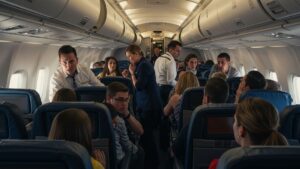
In terms of passengers, the unscheduled landing itself can be concerning, especially when hearing the “emergency” word. Communication between the cabin staff and pilots was excellent in this situation. They informed the passengers that this diversion was only precautionary and did not pose any imminent danger to passengers.
Passengers were asked to remain seated while landing. They were also escorted through the process of disembarking after that. United Airlines personnel helped passengers in rescheduling flights and accommodations, as well as getting access to meals if needed.
Though some delay and inconvenience were inevitable, good communications between crew members prevented panic and confusion.
Technological Review and Aircraft Safety
Upon landing, a complete check was carried out on the plane. Most of the modern airplanes available in the market, including Boeing 787, have the capacity to provide information in real-time to allow quick diagnosis of the problem.
Sometimes, diversions are prompted by sensor data or system messages suggesting possible problems rather than actual malfunctions. Safety philosophy in aviation stresses the importance of caution: it is always better to land prematurely rather than complete a long flight with uncertain aircraft systems.
Significantly, such occurrences show that safety mechanisms are doing their jobs, with anomalies being picked up early, thereby enabling teams to act decisively.
Why Emergency Diversions Are No Failures
To the layman, the emergency diversion itself appears alarming; however, in the aeronautics world, it merely symbolizes a successful safety diversion. Diversions are proactive in nature, maximizing safety against risks for the passengers, crew members, and aircraft.
A. Common Causes for Diversions:
- Alerts related to technical systems,
- Medical Emergencies On Board
- Weather hazards
- Unusual Vibrations Or Sensory Warning
- Operational issues at destination airports
In the case of United Airlines Flight UA770 Emergency Diversion of the flight constitutes adherence to best practices rather than failure in relation to flight safety.
Lessons from the UA770 Incident
The UA770 diversion provides several important insights:
Early Detection Saves Time and Lives
Modern monitoring systems enable the resolution of possible problems before they develop into a crisis.
Crew Training Is Imperative
Flight crew members are trained for abnormal occurrences, and they remain composed even under such situations.
Passenger Safety Comes First
Amanda Sandy, there are more factors to consider after these two, such as keeping the schedule intact, as well as the budget. But above all, it is important to encourage transparency, which helps in maintaining passenger confidence during an unexpected event.
Conclusion
An example illustrating this emphasis of contemporary aviation culture for safety, which is achieved through preparation and action, is that of the United Airlines flight UA770 Emergency Diversion. Though this particular incident disrupted travel, it stopped, of course, precisely as planned, with a smooth arrival and no one hurt.
Instead, these occurrences underscore the robustness of world aviation systems, which are intended to foretell and prepare for possible challenges before they become adverse. From a travelling perspective, this is yet another reminder of a fact that should always come first: for air travel, it is always better to err on the side of caution because it is a sign of strength, not weakness.
